Batched matched filter: design
D data segments and T template segments arrive as spectra: complex vectors of length N, the unnormalised forward transform of each segment. For every pair the output is
z_dt[k] = IFFT( D_d[f] * conj(H_t[f]) )[k]
returned either as every complex lag or as a binned maximum over a search window with a detection floor. D and T are arbitrary. The peak-only path never writes the full correlation; CorrelationFilter keeps the same fused spectral product but writes every lag. See full correlation for the output and memory tradeoff.
Where the time goes
Forward transforms number D+T. Pair work is D*T. At D=T=16 the pair loop is ~89% of the work before any optimisation, so every design decision is made about the pair loop.
Per pair, done naively:
read D_d N complex read H_t N complex write product P N complex read P N complex <- IFFT stage A write intermediate N complex read intermediate N complex
At 2^20 that is 48 MiB per pair, and 256 pairs is 12 GiB.
What reuse buys
1. Fuse the product into the IFFT's stage-A load. The product never has to exist in memory: stage A reads D_d and H_t and multiplies on the way in. Removes 2 of the 6 passes, 16 MiB of 48 per pair.
2. Pre-permute the stored spectra into stage-A order. Stage A reads x[n2*N1 + n1] walking n2, i.e. with stride N1, measured at 7.6 GB/s against 43.9 sequential on this core. Storing the spectra as X'[n1*N2 + n2] makes that read contiguous. The permutation costs one transpose per segment (D+T of them) instead of a strided read per pair (D*T of them): at D=T=16, 32 transposes to avoid 256 strided passes.
3. Cache-block the (d,t) loop. The matmul argument: a tile of nd×nt pairs loads nd+nt spectra and does nd*nt work, so traffic falls by roughly the harmonic mean where the spectra fit.
4. Conjugate templates once at ingest, not per pair.
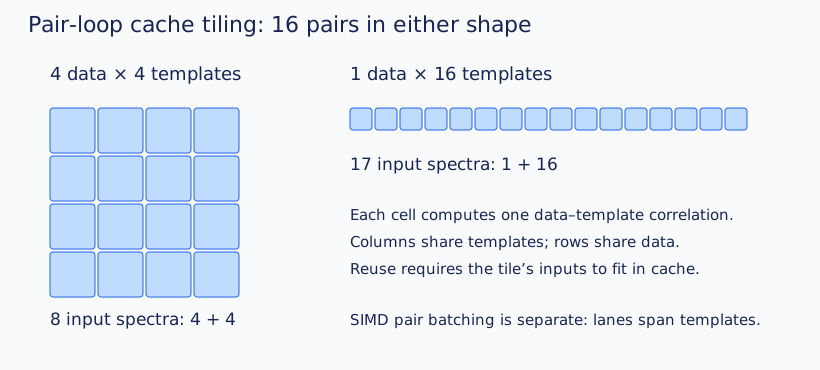
The diagram counts distinct inputs, not compulsory DRAM transfers: cache capacity and loop order determine the actual traffic. This cache tile is separate from SIMD pair batching, which currently fills lanes with templates for one data segment. A 32×1 batch therefore does not fill 32 SIMD lanes.
What does not work, and why
- Pushing butterflies across the product. The product is elementwise in frequency and butterflies mix frequencies, so no part of the IFFT can be pre-applied to
DorHseparately. Only the permutation commutes with an elementwise product, which is why (2) works and a pre-butterflied store does not. - Sharing IFFT work between pairs. Different pairs have different inputs; there is no common subexpression beyond what (1) to (3) already capture.
Why the input is frequency domain
Taking time-domain segments would let the ingest rearrangement fuse into a forward transform the library performed itself, making it free. Measured, that rearrangement is only 1.9 to 4.5% of total, and shrinks as T grows:
| N | D × T | ingest | pair loop | share |
|---|---|---|---|---|
| 2^12 | 16×16 | 26.7 µs | 652 µs | 3.9% |
| 2^12 | 16×256 | 228 µs | 11566 µs | 1.9% |
| 2^14 | 16×16 | 104 µs | 2940 µs | 3.4% |
| 2^16 | 16×64 | 2470 µs | 55566 µs | 4.3% |
Owning the forward transform is not worth that, and the caller's pipeline generally has the spectra already.